

Fully Funded
elena.navarro@uclm.es and jens@uvic.ca
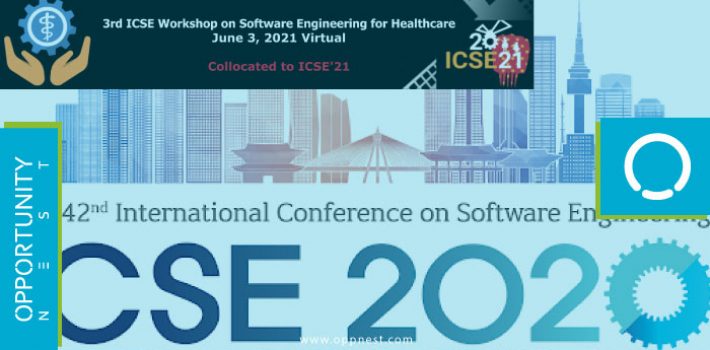
3rd ICSE International Workshop on Software Engineering for Healthcare 2021
Share on
Opportunity Type
Trainings
Fully Funded
Description
Healthcare systems in many countries are leveraging emerging technologies (e.g., cloud computing, big data, mobile apps, data science, biosensors, and wearable devices) and modern software engineering approaches to ensure continuous quality improvement in the presence of rapid change and increasing challenges. Software-intensive systems are seen as a key enabler for healthcare system reform in many jurisdictions with major investments and incentives to propel this transformation. At the same time, interoperability barriers continue to impede the composition of emergent healthcare systems, where different types of healthcare providers from different organizations need to coordinate efforts to deliver complex care. In this scenario, a community involving researchers and practitioners of software engineering for healthcare has emerged and shall continue to grow and mature, addressing diverse themes and their intersections.
Call For Papers – SEH 2021
Topics
This workshop will focus on discussing and establishing the theoretical foundations of software engineering for healthcare to develop and evolve complex health systems, paving the way for a more structured community effort. We expect to identify and characterize research that has effectively contributed to the patients’ quality of life and/or treatment outcome, pointing out further research directions. Finally, our goal is to continue developing an interdisciplinary, international community with an effective research, educational and industrial agenda for supporting software engineering in the healthcare sector. Hence, this workshop will focus on the combination of the following themes, but not limited to:
Software engineering: methods and techniques for modeling, designing, developing, and evaluating healthcare systems, software architecture extraction and description of healthcare systems, reference architectures, continuous architecting, architecting families of products, context awareness and autonomous computing, technical debt, software quality, development processes, user interface, system interoperability, cloud native applications, safety, security, sustainability, data governance, workflow integration, compliance and regulatory issues, and data analytics.
Healthcare systems: eHealth, mHealth, telehealth, electronic health records systems, medical devices, biomedical data, healthcare performance management, quality of care, medication adherence and health monitoring, electronic prescription, healthcare management systems, ageing users, standards, and clinical decision support. We look for papers that explore the above topics and the role that software engineering plays in creating solutions to address them. We are expressly interested in submissions from researchers in developing and underserved countries. We are also particularly interested in emerging trends in current practice submitted by those working in the healthcare domain.
Considering these themes, this workshop represents an important contribution for the software engineering and healthcare communities in terms of in-depth discussions and lessons learned, establishing a comprehensive research agenda for software engineering for healthcare.
Eligibilities
Oprn for all
Benefits
The workshop offers the participants the chance to feature their research papers and get the opportunity to discuss scientific and engineering ideas with other fellow researchers.
Program Venue
Online
Eligible Regions
All Regions
All Countries
select_all_regions
Eligible Countries
Afghanistan, Albania, Algeria, Andorra, Argentina, Angola, Africa, Antigua and Barbuda, Armenia, Australia, Austria, Azerbaijan, Bahamas, Bahrain, Bangladesh, Barbados, Belarus, Belgium, Belize, Benin, Bermuda, Bhutan, Bolivia, Bosnia and Herzegovina, Botswana, Brazil, Brunei, Bulgaria, Burkina Faso, Burundi, Cabo Verde, Cambodia, Cameroon, Canada, Cape Verde, Central African Republic, Chad, Chile, China, Colombia, Comoros, Congo, Democratic Republic, Costa Rica, Cote d’Ivoire, Croatia, Cuba, Cyprus, Czechia, Denmark, Djibouti, Dominica, Dominican Republic, Ecuador, Egypt, El Salvador, Equatorial Guinea, Eritrea, Estonia, Eswatini (formerly Swaziland), Ethiopia, Fiji, Finland, France, Gabon, Gambia, Georgia, Germany, Ghana, Greece, Greenland, Grenada, Guatemala, Guinea, Guinea-Bissau, Guyana, Haiti, Honduras, Hong Kong, Iceland, India, Indonesia, Iran, Iraq, Ireland, Israel, Italy, Jamaica, Japan, Jordan, Kazakhstan, Kenya, Kiribati, Kosovo, Kuwait, Kyrgyzstan, Laos, Latvia, Lebanon, Lesotho, Liberia, Libya, Liechtenstein, Lithuania, Luxembourg, Madagascar, Malawi, Malaysia, Maldives, Mali, Malta, Marshall Islands, Mauritania, Mauritius, Mexico, Micronesia, Moldova, Monaco, Mongolia, Montenegro, Morocco, Mozambique, Myanmar (formerly Burma), Namibia, Nauru, Nepal, Netherlands, New Zealand, Nicaragua, Niger, Nigeria, North Korea, North Macedonia (formerly Macedonia), Norway, Oman, Pakistan, Palau, Palestine, Panama, Papua New Guinea, Paraguay, Peru, Philippines, Poland, Portugal, Qatar, Romania, Russian Federation, Rwanda, Saint Kitts and Nevis, Saint Lucia, Saint Vincent and the Grenadines, Samoa, San Marino, Sao Tome and Principe, Saudi Arabia, Senegal, Serbia, Seychelles, Sierra Leone, Singapore, Slovakia, Slovenia, Solomon Islands, Somalia, South Africa, South Korea, South Sudan, Spain, Sri Lanka, Sudan, Suriname, Sweden, Switzerland, Syria, Taiwan, Tajikistan, Tanzania, Thailand, Timor-Leste, Tunisia, Togo, Tonga, Trinidad and Tobago, Turkey, Turkmenistan, Tuvalu, Uganda, Ukraine, UAE, UK, USA, Uruguay, Uzbekistan, Vanuatu, Vatican City (Holy See), Venezuela, Vietnam, Western Sahara, Yemen, Zambia, Zimbabwe, Hungary, Cook Island, Congo (Republic)
Application Process
Submission
Three types of submissions are invited:
Technical papers limited to 8 pages, presenting novel or tailored methods, processes, and tools for software engineering for healthcare;
Case studies limited to 8 pages, reporting experiments and/or industry experiences with one or more topics in the workshop; and
Short papers limited to 4 pages, reporting preliminary results of ongoing studies in the topics in this workshop, identifying relevant challenges or promising directions for engineering such systems.
The page limit includes all text, figures, tables, and references. All submissions must be unpublished original work and not be under review elsewhere. All papers will be judged on the basis of their clarity, relevance, originality, and contribution. Submissions must follow the IEEE Computer Science proceedings format, as workshop proceedings will be published by IEEE CS Digital Library. All submissions must be in English and submitted in PDF format through online upload to Easychair: https://easychair.org/conferences/?conf=seh2021
Publication of Papers
Accepted papers will be published in the electronic ICSA Proceedings in the IEEE Digital Library.
Important Dates
Submission deadline: Jan. 12, 2021
Notification: Feb. 22, 2021
Camera-ready copy: March. 12, 2021
SEH Workshop: June. 3rd, 2021
ADDITIONAL INFORMATION
Program Committee (Preliminary)
- Anirudh Aggarwal (Siemens Healthcare Private Limited, India)
- Pablo Oliveira Antonino (Fraunhofer IESE, Germany)
- George Avrunin (University of Massachusetts Amherst, USA)
- Rafael Capilla (Universidad Rey Juan Carlos, Spain)
- Yihai Chen (Shanghai University, China)
- Craig Kuziemsky (MacEwan University, Canada)
- Gunther Lenz (IBM Watson Health , USA)
- Zhiming Liu (Southwest University, China)
- Wendy MacCaull (St. Francis Xavier University, Canada)
- Silvana MacMahon (Dublin City University, Ireland)
- Bradley Malin (Vanderbilt University, USA)
- Dominique Méry (LORIA, France)
- Øystein Nytrø (Norwegian U. of Science and Tech., Norway)
- Lee Osterweil (University of Massachusetts, USA)
- Barbara Paech (University of Heidelberg, Germany)
- Liam Peyton (University of Ottawa, Canada)
- Ita Richardson (LERO, Univ. of Limerick, Ireland)
- Neeraj Singh (ENSEEIHT, Toulouse, France)
- Adel Taweel (Birziet University, Palestine)
- Jens Weber (Univ. of Victoria, Canada)
- Chuck Weinstock (Software Engineering Institute, USA)
Share on
Fully Funded
elena.navarro@uclm.es and jens@uvic.ca
3rd ICSE International Workshop on Software Engineering for Healthcare 2021
Share on
Opportunity Type
Trainings
Full Time
Description
Healthcare systems in many countries are leveraging emerging technologies (e.g., cloud computing, big data, mobile apps, data science, biosensors, and wearable devices) and modern software engineering approaches to ensure continuous quality improvement in the presence of rapid change and increasing challenges. Software-intensive systems are seen as a key enabler for healthcare system reform in many jurisdictions with major investments and incentives to propel this transformation. At the same time, interoperability barriers continue to impede the composition of emergent healthcare systems, where different types of healthcare providers from different organizations need to coordinate efforts to deliver complex care. In this scenario, a community involving researchers and practitioners of software engineering for healthcare has emerged and shall continue to grow and mature, addressing diverse themes and their intersections.
Call For Papers – SEH 2021
Topics
This workshop will focus on discussing and establishing the theoretical foundations of software engineering for healthcare to develop and evolve complex health systems, paving the way for a more structured community effort. We expect to identify and characterize research that has effectively contributed to the patients’ quality of life and/or treatment outcome, pointing out further research directions. Finally, our goal is to continue developing an interdisciplinary, international community with an effective research, educational and industrial agenda for supporting software engineering in the healthcare sector. Hence, this workshop will focus on the combination of the following themes, but not limited to:
Software engineering: methods and techniques for modeling, designing, developing, and evaluating healthcare systems, software architecture extraction and description of healthcare systems, reference architectures, continuous architecting, architecting families of products, context awareness and autonomous computing, technical debt, software quality, development processes, user interface, system interoperability, cloud native applications, safety, security, sustainability, data governance, workflow integration, compliance and regulatory issues, and data analytics.
Healthcare systems: eHealth, mHealth, telehealth, electronic health records systems, medical devices, biomedical data, healthcare performance management, quality of care, medication adherence and health monitoring, electronic prescription, healthcare management systems, ageing users, standards, and clinical decision support. We look for papers that explore the above topics and the role that software engineering plays in creating solutions to address them. We are expressly interested in submissions from researchers in developing and underserved countries. We are also particularly interested in emerging trends in current practice submitted by those working in the healthcare domain.
Considering these themes, this workshop represents an important contribution for the software engineering and healthcare communities in terms of in-depth discussions and lessons learned, establishing a comprehensive research agenda for software engineering for healthcare.
Eligibilities
Oprn for all
Benefits
The workshop offers the participants the chance to feature their research papers and get the opportunity to discuss scientific and engineering ideas with other fellow researchers.
Program Venue
Eligible Regions
All Regions
Eligible Countries
All Countries
Application Process
Submission
Three types of submissions are invited:
Technical papers limited to 8 pages, presenting novel or tailored methods, processes, and tools for software engineering for healthcare;
Case studies limited to 8 pages, reporting experiments and/or industry experiences with one or more topics in the workshop; and
Short papers limited to 4 pages, reporting preliminary results of ongoing studies in the topics in this workshop, identifying relevant challenges or promising directions for engineering such systems.
The page limit includes all text, figures, tables, and references. All submissions must be unpublished original work and not be under review elsewhere. All papers will be judged on the basis of their clarity, relevance, originality, and contribution. Submissions must follow the IEEE Computer Science proceedings format, as workshop proceedings will be published by IEEE CS Digital Library. All submissions must be in English and submitted in PDF format through online upload to Easychair: https://easychair.org/conferences/?conf=seh2021
Publication of Papers
Accepted papers will be published in the electronic ICSA Proceedings in the IEEE Digital Library.
Important Dates
Submission deadline: Jan. 12, 2021
Notification: Feb. 22, 2021
Camera-ready copy: March. 12, 2021
SEH Workshop: June. 3rd, 2021
ADDITIONAL INFORMATION
Program Committee (Preliminary)
- Anirudh Aggarwal (Siemens Healthcare Private Limited, India)
- Pablo Oliveira Antonino (Fraunhofer IESE, Germany)
- George Avrunin (University of Massachusetts Amherst, USA)
- Rafael Capilla (Universidad Rey Juan Carlos, Spain)
- Yihai Chen (Shanghai University, China)
- Craig Kuziemsky (MacEwan University, Canada)
- Gunther Lenz (IBM Watson Health , USA)
- Zhiming Liu (Southwest University, China)
- Wendy MacCaull (St. Francis Xavier University, Canada)
- Silvana MacMahon (Dublin City University, Ireland)
- Bradley Malin (Vanderbilt University, USA)
- Dominique Méry (LORIA, France)
- Øystein Nytrø (Norwegian U. of Science and Tech., Norway)
- Lee Osterweil (University of Massachusetts, USA)
- Barbara Paech (University of Heidelberg, Germany)
- Liam Peyton (University of Ottawa, Canada)
- Ita Richardson (LERO, Univ. of Limerick, Ireland)
- Neeraj Singh (ENSEEIHT, Toulouse, France)
- Adel Taweel (Birziet University, Palestine)
- Jens Weber (Univ. of Victoria, Canada)
- Chuck Weinstock (Software Engineering Institute, USA)
Share on
Fully Funded
elena.navarro@uclm.es and jens@uvic.ca
3rd ICSE International Workshop on Software Engineering for Healthcare 2021
Share on
Opportunity Type
Trainings
Select Type
Description
Healthcare systems in many countries are leveraging emerging technologies (e.g., cloud computing, big data, mobile apps, data science, biosensors, and wearable devices) and modern software engineering approaches to ensure continuous quality improvement in the presence of rapid change and increasing challenges. Software-intensive systems are seen as a key enabler for healthcare system reform in many jurisdictions with major investments and incentives to propel this transformation. At the same time, interoperability barriers continue to impede the composition of emergent healthcare systems, where different types of healthcare providers from different organizations need to coordinate efforts to deliver complex care. In this scenario, a community involving researchers and practitioners of software engineering for healthcare has emerged and shall continue to grow and mature, addressing diverse themes and their intersections.
Call For Papers – SEH 2021
Topics
This workshop will focus on discussing and establishing the theoretical foundations of software engineering for healthcare to develop and evolve complex health systems, paving the way for a more structured community effort. We expect to identify and characterize research that has effectively contributed to the patients’ quality of life and/or treatment outcome, pointing out further research directions. Finally, our goal is to continue developing an interdisciplinary, international community with an effective research, educational and industrial agenda for supporting software engineering in the healthcare sector. Hence, this workshop will focus on the combination of the following themes, but not limited to:
Software engineering: methods and techniques for modeling, designing, developing, and evaluating healthcare systems, software architecture extraction and description of healthcare systems, reference architectures, continuous architecting, architecting families of products, context awareness and autonomous computing, technical debt, software quality, development processes, user interface, system interoperability, cloud native applications, safety, security, sustainability, data governance, workflow integration, compliance and regulatory issues, and data analytics.
Healthcare systems: eHealth, mHealth, telehealth, electronic health records systems, medical devices, biomedical data, healthcare performance management, quality of care, medication adherence and health monitoring, electronic prescription, healthcare management systems, ageing users, standards, and clinical decision support. We look for papers that explore the above topics and the role that software engineering plays in creating solutions to address them. We are expressly interested in submissions from researchers in developing and underserved countries. We are also particularly interested in emerging trends in current practice submitted by those working in the healthcare domain.
Considering these themes, this workshop represents an important contribution for the software engineering and healthcare communities in terms of in-depth discussions and lessons learned, establishing a comprehensive research agenda for software engineering for healthcare.
Eligibilities
Oprn for all
Benefits
The workshop offers the participants the chance to feature their research papers and get the opportunity to discuss scientific and engineering ideas with other fellow researchers.
Program Venue
Eligible Regions
All Regions
Eligible Countries
All Countries
Application Process
Submission
Three types of submissions are invited:
Technical papers limited to 8 pages, presenting novel or tailored methods, processes, and tools for software engineering for healthcare;
Case studies limited to 8 pages, reporting experiments and/or industry experiences with one or more topics in the workshop; and
Short papers limited to 4 pages, reporting preliminary results of ongoing studies in the topics in this workshop, identifying relevant challenges or promising directions for engineering such systems.
The page limit includes all text, figures, tables, and references. All submissions must be unpublished original work and not be under review elsewhere. All papers will be judged on the basis of their clarity, relevance, originality, and contribution. Submissions must follow the IEEE Computer Science proceedings format, as workshop proceedings will be published by IEEE CS Digital Library. All submissions must be in English and submitted in PDF format through online upload to Easychair: https://easychair.org/conferences/?conf=seh2021
Publication of Papers
Accepted papers will be published in the electronic ICSA Proceedings in the IEEE Digital Library.
Important Dates
Submission deadline: Jan. 12, 2021
Notification: Feb. 22, 2021
Camera-ready copy: March. 12, 2021
SEH Workshop: June. 3rd, 2021
ADDITIONAL INFORMATION
Program Committee (Preliminary)
- Anirudh Aggarwal (Siemens Healthcare Private Limited, India)
- Pablo Oliveira Antonino (Fraunhofer IESE, Germany)
- George Avrunin (University of Massachusetts Amherst, USA)
- Rafael Capilla (Universidad Rey Juan Carlos, Spain)
- Yihai Chen (Shanghai University, China)
- Craig Kuziemsky (MacEwan University, Canada)
- Gunther Lenz (IBM Watson Health , USA)
- Zhiming Liu (Southwest University, China)
- Wendy MacCaull (St. Francis Xavier University, Canada)
- Silvana MacMahon (Dublin City University, Ireland)
- Bradley Malin (Vanderbilt University, USA)
- Dominique Méry (LORIA, France)
- Øystein Nytrø (Norwegian U. of Science and Tech., Norway)
- Lee Osterweil (University of Massachusetts, USA)
- Barbara Paech (University of Heidelberg, Germany)
- Liam Peyton (University of Ottawa, Canada)
- Ita Richardson (LERO, Univ. of Limerick, Ireland)
- Neeraj Singh (ENSEEIHT, Toulouse, France)
- Adel Taweel (Birziet University, Palestine)
- Jens Weber (Univ. of Victoria, Canada)
- Chuck Weinstock (Software Engineering Institute, USA)
Share on
Fully Funded
Opening Date
3rd ICSE International Workshop on Software Engineering for Healthcare 2021

FUNDING TYPE
Description
Healthcare systems in many countries are leveraging emerging technologies (e.g., cloud computing, big data, mobile apps, data science, biosensors, and wearable devices) and modern software engineering approaches to ensure continuous quality improvement in the presence of rapid change and increasing challenges. Software-intensive systems are seen as a key enabler for healthcare system reform in many jurisdictions with major investments and incentives to propel this transformation. At the same time, interoperability barriers continue to impede the composition of emergent healthcare systems, where different types of healthcare providers from different organizations need to coordinate efforts to deliver complex care. In this scenario, a community involving researchers and practitioners of software engineering for healthcare has emerged and shall continue to grow and mature, addressing diverse themes and their intersections.
Call For Papers – SEH 2021
Topics
This workshop will focus on discussing and establishing the theoretical foundations of software engineering for healthcare to develop and evolve complex health systems, paving the way for a more structured community effort. We expect to identify and characterize research that has effectively contributed to the patients’ quality of life and/or treatment outcome, pointing out further research directions. Finally, our goal is to continue developing an interdisciplinary, international community with an effective research, educational and industrial agenda for supporting software engineering in the healthcare sector. Hence, this workshop will focus on the combination of the following themes, but not limited to:
Software engineering: methods and techniques for modeling, designing, developing, and evaluating healthcare systems, software architecture extraction and description of healthcare systems, reference architectures, continuous architecting, architecting families of products, context awareness and autonomous computing, technical debt, software quality, development processes, user interface, system interoperability, cloud native applications, safety, security, sustainability, data governance, workflow integration, compliance and regulatory issues, and data analytics.
Healthcare systems: eHealth, mHealth, telehealth, electronic health records systems, medical devices, biomedical data, healthcare performance management, quality of care, medication adherence and health monitoring, electronic prescription, healthcare management systems, ageing users, standards, and clinical decision support. We look for papers that explore the above topics and the role that software engineering plays in creating solutions to address them. We are expressly interested in submissions from researchers in developing and underserved countries. We are also particularly interested in emerging trends in current practice submitted by those working in the healthcare domain.
Considering these themes, this workshop represents an important contribution for the software engineering and healthcare communities in terms of in-depth discussions and lessons learned, establishing a comprehensive research agenda for software engineering for healthcare.
BENIFITS
The workshop offers the participants the chance to feature their research papers and get the opportunity to discuss scientific and engineering ideas with other fellow researchers.
Eligibilities
Oprn for all
For Further Queries:
elena.navarro@uclm.es and jens@uvic.ca
Eligible Regions:
Program Venue:
APPLICATION PROCESS
Submission
Three types of submissions are invited:
Technical papers limited to 8 pages, presenting novel or tailored methods, processes, and tools for software engineering for healthcare;
Case studies limited to 8 pages, reporting experiments and/or industry experiences with one or more topics in the workshop; and
Short papers limited to 4 pages, reporting preliminary results of ongoing studies in the topics in this workshop, identifying relevant challenges or promising directions for engineering such systems.
The page limit includes all text, figures, tables, and references. All submissions must be unpublished original work and not be under review elsewhere. All papers will be judged on the basis of their clarity, relevance, originality, and contribution. Submissions must follow the IEEE Computer Science proceedings format, as workshop proceedings will be published by IEEE CS Digital Library. All submissions must be in English and submitted in PDF format through online upload to Easychair: https://easychair.org/conferences/?conf=seh2021
Publication of Papers
Accepted papers will be published in the electronic ICSA Proceedings in the IEEE Digital Library.
Important Dates
Submission deadline: Jan. 12, 2021
Notification: Feb. 22, 2021
Camera-ready copy: March. 12, 2021
SEH Workshop: June. 3rd, 2021
Recent Articles
-

IELTS Ultimate Guide – Preparation Tips, Format and Test Day Tips
January 29, 2021 -
Free Artist Residencies in Europe For Emerging Artists
January 21, 2021 -

How To Write A Personal Statement
December 22, 2020
Related Posts
-

FAOU Spring Internship 2021
January 18, 2021 -

-
