
Fully Funded
For general queries about the Global Campus MOOC on Children Deprived of Liberty: Enacting the Recommendations of the UN Global Study you can drop an e-mail to e-learning@gchumanrights.org
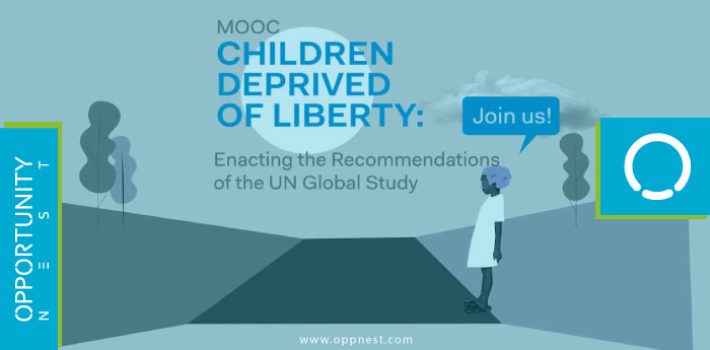
Children Deprived of Liberty: Enacting the Recommendations of the UN Global Study
Share on
Opportunity Type
Trainings
Fully Funded
Description
In 2019 the UN Global Study on Children Deprived of Liberty drew the world’s attention to an appalling reality: more than seven million children worldwide are deprived of liberty every year. Still a conservative estimate, this figure stands in direct contrast to the requirement of the Convention on the Rights of the Child (CRC), which clearly states that the detention of children shall be used only as a measure of last resort — that is, only in exceptional circumstances, on a case-by-case basis, if non-custodial solutions are not available or appropriate.
Although some progress has already been achieved in recent years, and some promising practices bode well for the future, much more needs to be done. Whether we look at unaccompanied children detained in migration centres or children being charged in the context of counter-terrorism or held prisoners as child soldiers in the context of armed conflict, their numbers and their living conditions are still unacceptable under the standards set out in the CRC. Moreover, they unfortunately share a similar fate with millions of other children. Indeed, in addition to the cases in the administration of justice, deprivation of liberty still occurs also for children living with imprisoned caregivers or in institutions of all kinds, including institutions for children with disabilities.
The UN Global Study has not only provided an assessment on the standing of children’s deprivation of liberty in such a range of contexts, but also – very importantly – set out clear recommendations for change. This roadmap is an inspiration for new laws, policies, and practices that can help States dramatically reduce the number of children behind bars and locked doors. Keeping the conversation going and monitoring the enactment of the recommendations is key to ensure that children worldwide are no longer deprived of their childhood.
This MOOC is a complement to a previous Global Campus course on the Global Study and aims at providing updated information on situations, challenges and possible solutions as they are being envisaged in each region of the world. Hearing from experts, researchers, and children themselves, participants will learn about steps being taken in terms of deinstitutionalisation, diversion, ending migration-related detention and other measures.
Eligibilities
We designed this course for participants around the world who are actively interested and engaged in children’s rights work and wish to deepen their knowledge about the protection of children deprived of liberty and related developments, key issues and possibilities for transformation.
Benefits
At the end of the course, participants who have successfully completed all discussions and quizzes will receive a free certificate confirming their participation.
Upon completion of this course participants will have gained:
- Knowledge about key standards, documents and recommendations contained in the UN Global Study
- Understanding of progress and obstacles in terms of more viable measures of implementation, from the point of view of UN agencies, states, civil society and other affected rights-holders, in particular children
- Ability to identify multi-faceted aspects (pros and cons of each side of the matter)
- Capacity to discuss specific regional issues and groups/cases of concern
Program Venue
Online
Eligible Regions
All Regions
All Countries
select_all_regions
Eligible Countries
Afghanistan, Albania, Algeria, Andorra, Argentina, Angola, Africa, Antigua and Barbuda, Armenia, Australia, Austria, Azerbaijan, Bahamas, Bahrain, Bangladesh, Barbados, Belarus, Belgium, Belize, Benin, Bermuda, Bhutan, Bolivia, Bosnia and Herzegovina, Botswana, Brazil, Brunei, Bulgaria, Burkina Faso, Burundi, Cabo Verde, Cambodia, Cameroon, Canada, Cape Verde, Central African Republic, Chad, Chile, China, Colombia, Comoros, Congo, Democratic Republic, Costa Rica, Cote d’Ivoire, Croatia, Cuba, Cyprus, Czechia, Denmark, Djibouti, Dominica, Dominican Republic, Ecuador, Egypt, El Salvador, Equatorial Guinea, Eritrea, Estonia, Eswatini (formerly Swaziland), Ethiopia, Fiji, Finland, France, Gabon, Gambia, Georgia, Germany, Ghana, Greece, Greenland, Grenada, Guatemala, Guinea, Guinea-Bissau, Guyana, Haiti, Honduras, Hong Kong, Iceland, India, Indonesia, Iran, Iraq, Ireland, Israel, Italy, Jamaica, Japan, Jordan, Kazakhstan, Kenya, Kiribati, Kosovo, Kuwait, Kyrgyzstan, Laos, Latvia, Lebanon, Lesotho, Liberia, Libya, Liechtenstein, Lithuania, Luxembourg, Madagascar, Malawi, Malaysia, Maldives, Mali, Malta, Marshall Islands, Mauritania, Mauritius, Mexico, Micronesia, Moldova, Monaco, Mongolia, Montenegro, Morocco, Mozambique, Myanmar (formerly Burma), Namibia, Nauru, Nepal, Netherlands, New Zealand, Nicaragua, Niger, Nigeria, North Korea, North Macedonia (formerly Macedonia), Norway, Oman, Pakistan, Palau, Palestine, Panama, Papua New Guinea, Paraguay, Peru, Philippines, Poland, Portugal, Qatar, Romania, Russian Federation, Rwanda, Saint Kitts and Nevis, Saint Lucia, Saint Vincent and the Grenadines, Samoa, San Marino, Sao Tome and Principe, Saudi Arabia, Senegal, Serbia, Seychelles, Sierra Leone, Singapore, Slovakia, Slovenia, Solomon Islands, Somalia, South Africa, South Korea, South Sudan, Spain, Sri Lanka, Sudan, Suriname, Sweden, Switzerland, Syria, Taiwan, Tajikistan, Tanzania, Thailand, Timor-Leste, Tunisia, Togo, Tonga, Trinidad and Tobago, Turkey, Turkmenistan, Tuvalu, Uganda, Ukraine, UAE, UK, USA, Uruguay, Uzbekistan, Vanuatu, Vatican City (Holy See), Venezuela, Vietnam, Western Sahara, Yemen, Zambia, Zimbabwe, Hungary, Cook Island, Congo (Republic)
Application Process
How to Enrol
The MOOC on Children Deprived of Liberty: Enacting the Recommendations of the UN Global Study is free and open to participants (students; governmental, inter-governmental and non-governmental staff; social workers; researchers; committed citizens…) from all over the world who are actively interested and engaged in children’s rights work and wish to deepen their knowledge about the protection of children deprived of liberty and related developments, key issues and possibilities for transformation.
The course is offered on OpenEdX, the open source platform of EdX which is one of the leading providers of open online learning. With a user-friendly and innovative interface, our course offers an interactive and engaging learning experience without geographical limitations, allowing participants to enjoy being part of a truly global network of experts and committed human rights defenders.
Course dates: 23 November 2020 – 10 January 2021.
Free enrolment: until 27 December 2020.
ADDITIONAL INFORMATION
Methodology
The course encompasses a 7-weeks period. Participants are expected to engage in approximately 35 hours of active learning through readings, videos, discussions, and quizzes. The course is based on a participatory approach aimed at developing and reinforcing personal critical reflection and peer-to-peer learning. Examples from different areas of the world and on different themes allow the identification of cross-regional and cross-cutting issues and enable a global and multidimensional understanding of the topic.
Course Outline
The course is articulated in two modules:
Module 1 is an introduction to the UN Global Study as a framework for action. Specific attention will be paid here to the Study’s recommendations and the developing follow-up initiatives which are being enacted in cooperation with different stakeholders, from UN agencies to governments, from civil society to academia.
Module 2 is dedicated to regional perspectives and a variety of recent initiatives, examples and practices that are being implemented there. In so doing, the course specifically analyses the most relevant issues and themes in each region: from immigration detention to deinstitutionalisation, from deprivation of liberty for national security reasons, to diversion measures.
Share on
Fully Funded
For general queries about the Global Campus MOOC on Children Deprived of Liberty: Enacting the Recommendations of the UN Global Study you can drop an e-mail to e-learning@gchumanrights.org
Children Deprived of Liberty: Enacting the Recommendations of the UN Global Study
Share on
Opportunity Type
Trainings
Full Time
Description
In 2019 the UN Global Study on Children Deprived of Liberty drew the world’s attention to an appalling reality: more than seven million children worldwide are deprived of liberty every year. Still a conservative estimate, this figure stands in direct contrast to the requirement of the Convention on the Rights of the Child (CRC), which clearly states that the detention of children shall be used only as a measure of last resort — that is, only in exceptional circumstances, on a case-by-case basis, if non-custodial solutions are not available or appropriate.
Although some progress has already been achieved in recent years, and some promising practices bode well for the future, much more needs to be done. Whether we look at unaccompanied children detained in migration centres or children being charged in the context of counter-terrorism or held prisoners as child soldiers in the context of armed conflict, their numbers and their living conditions are still unacceptable under the standards set out in the CRC. Moreover, they unfortunately share a similar fate with millions of other children. Indeed, in addition to the cases in the administration of justice, deprivation of liberty still occurs also for children living with imprisoned caregivers or in institutions of all kinds, including institutions for children with disabilities.
The UN Global Study has not only provided an assessment on the standing of children’s deprivation of liberty in such a range of contexts, but also – very importantly – set out clear recommendations for change. This roadmap is an inspiration for new laws, policies, and practices that can help States dramatically reduce the number of children behind bars and locked doors. Keeping the conversation going and monitoring the enactment of the recommendations is key to ensure that children worldwide are no longer deprived of their childhood.
This MOOC is a complement to a previous Global Campus course on the Global Study and aims at providing updated information on situations, challenges and possible solutions as they are being envisaged in each region of the world. Hearing from experts, researchers, and children themselves, participants will learn about steps being taken in terms of deinstitutionalisation, diversion, ending migration-related detention and other measures.
Eligibilities
We designed this course for participants around the world who are actively interested and engaged in children’s rights work and wish to deepen their knowledge about the protection of children deprived of liberty and related developments, key issues and possibilities for transformation.
Benefits
At the end of the course, participants who have successfully completed all discussions and quizzes will receive a free certificate confirming their participation.
Upon completion of this course participants will have gained:
- Knowledge about key standards, documents and recommendations contained in the UN Global Study
- Understanding of progress and obstacles in terms of more viable measures of implementation, from the point of view of UN agencies, states, civil society and other affected rights-holders, in particular children
- Ability to identify multi-faceted aspects (pros and cons of each side of the matter)
- Capacity to discuss specific regional issues and groups/cases of concern
Program Venue
Eligible Regions
All Regions
Eligible Countries
All Countries
Application Process
How to Enrol
The MOOC on Children Deprived of Liberty: Enacting the Recommendations of the UN Global Study is free and open to participants (students; governmental, inter-governmental and non-governmental staff; social workers; researchers; committed citizens…) from all over the world who are actively interested and engaged in children’s rights work and wish to deepen their knowledge about the protection of children deprived of liberty and related developments, key issues and possibilities for transformation.
The course is offered on OpenEdX, the open source platform of EdX which is one of the leading providers of open online learning. With a user-friendly and innovative interface, our course offers an interactive and engaging learning experience without geographical limitations, allowing participants to enjoy being part of a truly global network of experts and committed human rights defenders.
Course dates: 23 November 2020 – 10 January 2021.
Free enrolment: until 27 December 2020.
ADDITIONAL INFORMATION
Methodology
The course encompasses a 7-weeks period. Participants are expected to engage in approximately 35 hours of active learning through readings, videos, discussions, and quizzes. The course is based on a participatory approach aimed at developing and reinforcing personal critical reflection and peer-to-peer learning. Examples from different areas of the world and on different themes allow the identification of cross-regional and cross-cutting issues and enable a global and multidimensional understanding of the topic.
Course Outline
The course is articulated in two modules:
Module 1 is an introduction to the UN Global Study as a framework for action. Specific attention will be paid here to the Study’s recommendations and the developing follow-up initiatives which are being enacted in cooperation with different stakeholders, from UN agencies to governments, from civil society to academia.
Module 2 is dedicated to regional perspectives and a variety of recent initiatives, examples and practices that are being implemented there. In so doing, the course specifically analyses the most relevant issues and themes in each region: from immigration detention to deinstitutionalisation, from deprivation of liberty for national security reasons, to diversion measures.
Share on
Fully Funded
For general queries about the Global Campus MOOC on Children Deprived of Liberty: Enacting the Recommendations of the UN Global Study you can drop an e-mail to e-learning@gchumanrights.org
Children Deprived of Liberty: Enacting the Recommendations of the UN Global Study
Share on
Opportunity Type
Trainings
Select Type
Description
In 2019 the UN Global Study on Children Deprived of Liberty drew the world’s attention to an appalling reality: more than seven million children worldwide are deprived of liberty every year. Still a conservative estimate, this figure stands in direct contrast to the requirement of the Convention on the Rights of the Child (CRC), which clearly states that the detention of children shall be used only as a measure of last resort — that is, only in exceptional circumstances, on a case-by-case basis, if non-custodial solutions are not available or appropriate.
Although some progress has already been achieved in recent years, and some promising practices bode well for the future, much more needs to be done. Whether we look at unaccompanied children detained in migration centres or children being charged in the context of counter-terrorism or held prisoners as child soldiers in the context of armed conflict, their numbers and their living conditions are still unacceptable under the standards set out in the CRC. Moreover, they unfortunately share a similar fate with millions of other children. Indeed, in addition to the cases in the administration of justice, deprivation of liberty still occurs also for children living with imprisoned caregivers or in institutions of all kinds, including institutions for children with disabilities.
The UN Global Study has not only provided an assessment on the standing of children’s deprivation of liberty in such a range of contexts, but also – very importantly – set out clear recommendations for change. This roadmap is an inspiration for new laws, policies, and practices that can help States dramatically reduce the number of children behind bars and locked doors. Keeping the conversation going and monitoring the enactment of the recommendations is key to ensure that children worldwide are no longer deprived of their childhood.
This MOOC is a complement to a previous Global Campus course on the Global Study and aims at providing updated information on situations, challenges and possible solutions as they are being envisaged in each region of the world. Hearing from experts, researchers, and children themselves, participants will learn about steps being taken in terms of deinstitutionalisation, diversion, ending migration-related detention and other measures.
Eligibilities
We designed this course for participants around the world who are actively interested and engaged in children’s rights work and wish to deepen their knowledge about the protection of children deprived of liberty and related developments, key issues and possibilities for transformation.
Benefits
At the end of the course, participants who have successfully completed all discussions and quizzes will receive a free certificate confirming their participation.
Upon completion of this course participants will have gained:
- Knowledge about key standards, documents and recommendations contained in the UN Global Study
- Understanding of progress and obstacles in terms of more viable measures of implementation, from the point of view of UN agencies, states, civil society and other affected rights-holders, in particular children
- Ability to identify multi-faceted aspects (pros and cons of each side of the matter)
- Capacity to discuss specific regional issues and groups/cases of concern
Program Venue
Eligible Regions
All Regions
Eligible Countries
All Countries
Application Process
How to Enrol
The MOOC on Children Deprived of Liberty: Enacting the Recommendations of the UN Global Study is free and open to participants (students; governmental, inter-governmental and non-governmental staff; social workers; researchers; committed citizens…) from all over the world who are actively interested and engaged in children’s rights work and wish to deepen their knowledge about the protection of children deprived of liberty and related developments, key issues and possibilities for transformation.
The course is offered on OpenEdX, the open source platform of EdX which is one of the leading providers of open online learning. With a user-friendly and innovative interface, our course offers an interactive and engaging learning experience without geographical limitations, allowing participants to enjoy being part of a truly global network of experts and committed human rights defenders.
Course dates: 23 November 2020 – 10 January 2021.
Free enrolment: until 27 December 2020.
ADDITIONAL INFORMATION
Methodology
The course encompasses a 7-weeks period. Participants are expected to engage in approximately 35 hours of active learning through readings, videos, discussions, and quizzes. The course is based on a participatory approach aimed at developing and reinforcing personal critical reflection and peer-to-peer learning. Examples from different areas of the world and on different themes allow the identification of cross-regional and cross-cutting issues and enable a global and multidimensional understanding of the topic.
Course Outline
The course is articulated in two modules:
Module 1 is an introduction to the UN Global Study as a framework for action. Specific attention will be paid here to the Study’s recommendations and the developing follow-up initiatives which are being enacted in cooperation with different stakeholders, from UN agencies to governments, from civil society to academia.
Module 2 is dedicated to regional perspectives and a variety of recent initiatives, examples and practices that are being implemented there. In so doing, the course specifically analyses the most relevant issues and themes in each region: from immigration detention to deinstitutionalisation, from deprivation of liberty for national security reasons, to diversion measures.
Share on
Fully Funded
Opening Date
Children Deprived of Liberty: Enacting the Recommendations of the UN Global Study

FUNDING TYPE
Description
In 2019 the UN Global Study on Children Deprived of Liberty drew the world’s attention to an appalling reality: more than seven million children worldwide are deprived of liberty every year. Still a conservative estimate, this figure stands in direct contrast to the requirement of the Convention on the Rights of the Child (CRC), which clearly states that the detention of children shall be used only as a measure of last resort — that is, only in exceptional circumstances, on a case-by-case basis, if non-custodial solutions are not available or appropriate.
Although some progress has already been achieved in recent years, and some promising practices bode well for the future, much more needs to be done. Whether we look at unaccompanied children detained in migration centres or children being charged in the context of counter-terrorism or held prisoners as child soldiers in the context of armed conflict, their numbers and their living conditions are still unacceptable under the standards set out in the CRC. Moreover, they unfortunately share a similar fate with millions of other children. Indeed, in addition to the cases in the administration of justice, deprivation of liberty still occurs also for children living with imprisoned caregivers or in institutions of all kinds, including institutions for children with disabilities.
The UN Global Study has not only provided an assessment on the standing of children’s deprivation of liberty in such a range of contexts, but also – very importantly – set out clear recommendations for change. This roadmap is an inspiration for new laws, policies, and practices that can help States dramatically reduce the number of children behind bars and locked doors. Keeping the conversation going and monitoring the enactment of the recommendations is key to ensure that children worldwide are no longer deprived of their childhood.
This MOOC is a complement to a previous Global Campus course on the Global Study and aims at providing updated information on situations, challenges and possible solutions as they are being envisaged in each region of the world. Hearing from experts, researchers, and children themselves, participants will learn about steps being taken in terms of deinstitutionalisation, diversion, ending migration-related detention and other measures.
BENIFITS
At the end of the course, participants who have successfully completed all discussions and quizzes will receive a free certificate confirming their participation.
Upon completion of this course participants will have gained:
- Knowledge about key standards, documents and recommendations contained in the UN Global Study
- Understanding of progress and obstacles in terms of more viable measures of implementation, from the point of view of UN agencies, states, civil society and other affected rights-holders, in particular children
- Ability to identify multi-faceted aspects (pros and cons of each side of the matter)
- Capacity to discuss specific regional issues and groups/cases of concern
Eligibilities
We designed this course for participants around the world who are actively interested and engaged in children’s rights work and wish to deepen their knowledge about the protection of children deprived of liberty and related developments, key issues and possibilities for transformation.
For Further Queries:
For general queries about the Global Campus MOOC on Children Deprived of Liberty: Enacting the Recommendations of the UN Global Study you can drop an e-mail to e-learning@gchumanrights.org
Eligible Regions:
Program Venue:
APPLICATION PROCESS
How to Enrol
The MOOC on Children Deprived of Liberty: Enacting the Recommendations of the UN Global Study is free and open to participants (students; governmental, inter-governmental and non-governmental staff; social workers; researchers; committed citizens…) from all over the world who are actively interested and engaged in children’s rights work and wish to deepen their knowledge about the protection of children deprived of liberty and related developments, key issues and possibilities for transformation.
The course is offered on OpenEdX, the open source platform of EdX which is one of the leading providers of open online learning. With a user-friendly and innovative interface, our course offers an interactive and engaging learning experience without geographical limitations, allowing participants to enjoy being part of a truly global network of experts and committed human rights defenders.
Course dates: 23 November 2020 – 10 January 2021.
Free enrolment: until 27 December 2020.
Recent Articles
-

IELTS Ultimate Guide – Preparation Tips, Format and Test Day Tips
January 29, 2021 -
Free Artist Residencies in Europe For Emerging Artists
January 21, 2021 -

How To Write A Personal Statement
December 22, 2020
Related Posts
-

FAOU Spring Internship 2021
January 18, 2021 -

-
